
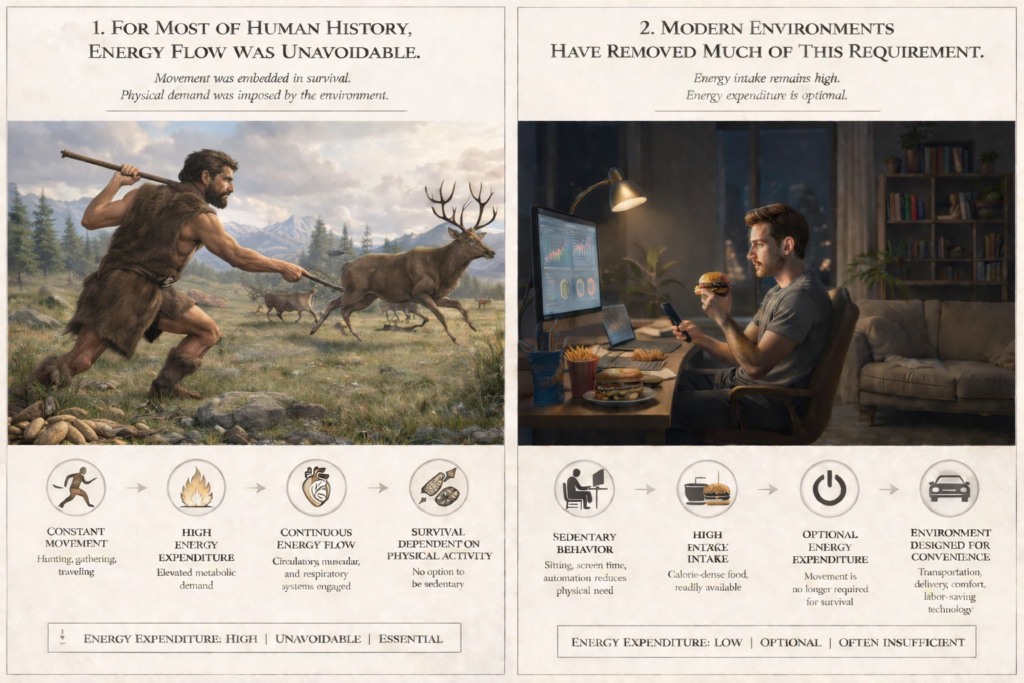
Modern life has changed the relationship between the human body and its environment.
For most of human history, survival required movement.
Energy intake and energy use were tightly connected.
Today, that relationship is broken.
A System Designed for Demand
The human body is built to operate under continuous demand.
Movement drives:
- circulation
- metabolism
- muscular function
- neurological activity
Energy flows through the system in response to use.
Capacity is maintained because it is required.
The Shift
Modern environments have removed that requirement.
Food is abundant.
Movement is optional.
Effort is minimized.
Energy can now enter the system without being used.
This creates a separation:
Intake no longer follows demand.
The Mismatch
This separation produces a structural mismatch:
- High energy availability
- Low energy flow
The body receives more energy than it needs to process,
while simultaneously receiving fewer signals to maintain capacity.
What the Body Does
The body does not resist this. It adapts.
When demand decreases:
- muscle mass declines
- metabolic flexibility reduces
- cardiovascular capacity narrows
At the same time, unused energy is stored.
These are not failures.
They are consistent biological responses.
Capacity follows demand.
The Hidden Cost
This process is gradual.
The system remains functional, but within a narrower range.
Over time:
- efficiency decreases
- adaptability declines
- reserve capacity is reduced
The gap widens between:
- what the body has
- and what the body can use
This is the Modern Mismatch.
The Paradox
Modern life creates a paradox:
- Energy is abundant
- But energy flow is limited
As a result:
- energy is stored rather than used
- systems are under-stimulated
- capacity declines despite excess
Not a Failure of Discipline
This is not primarily a behavioral problem.
It is a structural condition.
The environment:
- reduces demand
- increases access
- reinforces low-effort patterns
The body simply responds to these signals.
Closing the Gap
To resolve the mismatch, the relationship must be restored:
Energy intake must reconnect with energy use.
This is where exercise becomes essential.
Not as optional fitness,
but as a way to reintroduce demand into a system that no longer requires it.
Core Principle
The body does not maintain capacity out of obligation. It maintains what is used—and removes what is not.