
Exercise Decoding
Restoring the conditions under which the human organism remains functional.
The Foundation of Organism – Regulated Energy
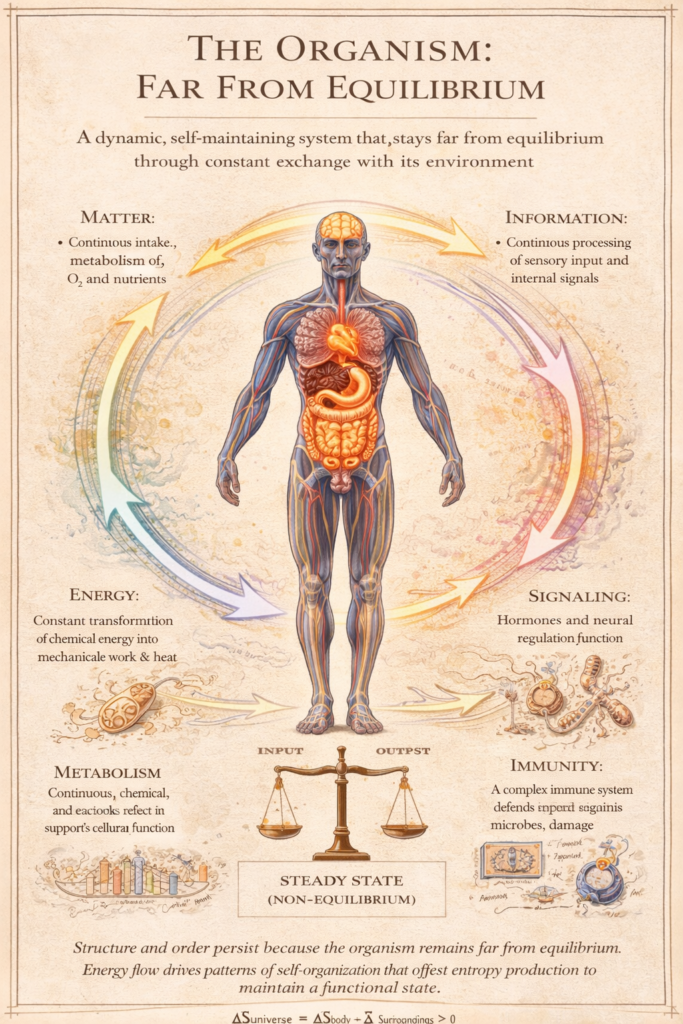
The human body is not a static object. It is an organized, dynamic system.
At every level—cellular, tissue, and systemic—the organism maintains its structure through continuous processes of exchange, repair, and adaptation. This organization is not permanent. It must be actively sustained.
From a thermodynamic perspective, living systems exist in a state far from equilibrium. Left without input, they do not remain stable. They degrade. This tendency toward disorder is not a failure of the system. It is a fundamental property of the physical world.
To maintain structure, the organism depends on the continuous flow of energy. Energy enters, is transformed, and is distributed across systems to support: coordinated physiological activity, cellular function and tissue integrity.
The Vital of Life – Energy Flow
1. Decline and Entropy
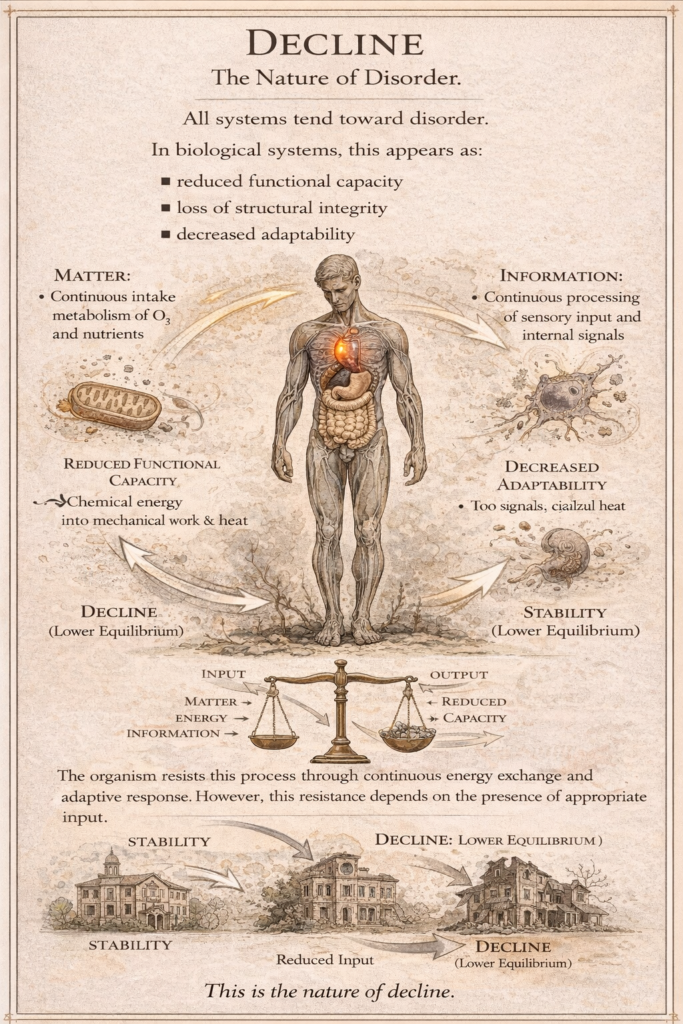
All organized systems tend toward disorder. In biological systems, this appears as a gradual reduction in structure and function:
- decreased strength and stability
- reduced cardiovascular capacity
- impaired metabolic regulation
- diminished responsiveness and adaptability
This process is not abrupt. It unfolds slowly, often without immediate awareness.
The organism resists this tendency through continuous energy flow. Energy supports repair, regulation, and coordination across systems.
However, living systems exist by resisting entropy through continuous energy flow, and this resistance is conditional.
When energy flow is insufficient—particularly through pathways of movement and activity—the organism does not fail. It reorganizes.
Capacity is reduced. Function is preserved at a lower level. This is decline.
From a thermodynamic perspective, this is expected. Entropy is not an event. It is the default direction.
But the biological system is not passive. Through homeostasis, it stabilizes internal conditions despite fluctuations in external input. Surplus energy can be buffered. Short-term deficits can be compensated.
Yet this stability is temporary.
The organism does not exist in a state of permanent balance. It operates across cycles:
- periods of relative surplus
- periods of balance
- and recurring phases of insufficiency
Over time, without sufficient demand to drive energy through the system, the baseline shifts downward. Decline is not caused by a single deficit. It emerges from the absence of sustained demand that justifies higher capacity.
2. Demand and Adaptation
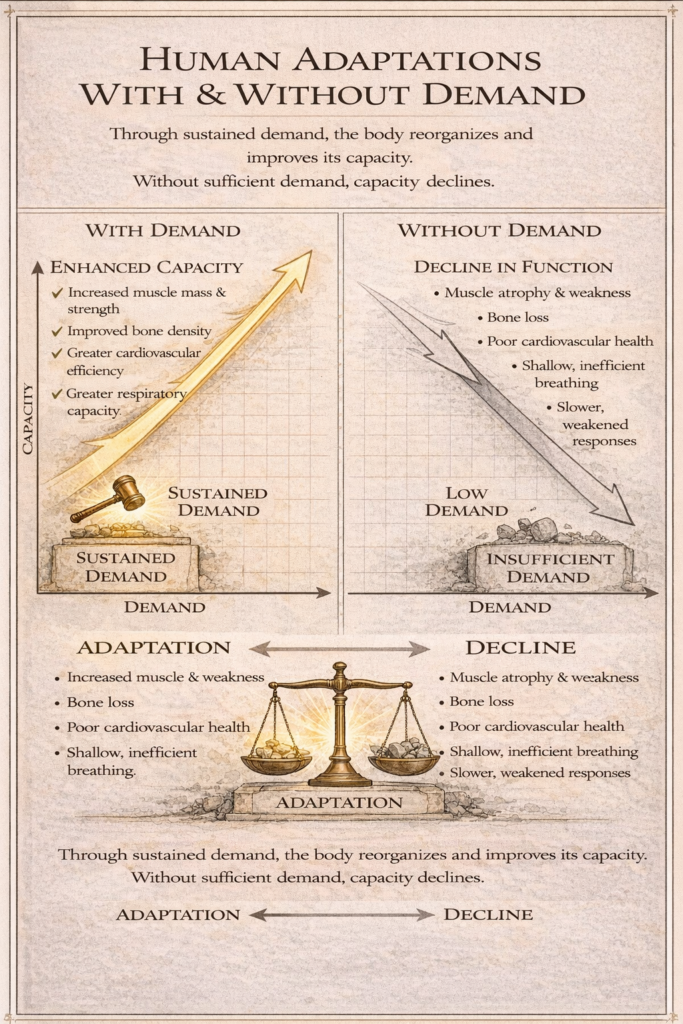
As the organism resists decline through continuous energy flow, demand becomes the primary drive and mechanism that sustains and regulates that flow.
When the organism is exposed to increased or repeated demand—whether through movement, mechanical work, or structured exercise—energy flow increases.
This increase is not passive. It is directed, distributed, and reinforced through biological systems. Over time, the organism adapts:
- muscles become stronger
- bones become denser
- cardiovascular efficiency improves
- respiratory capacity expands
- coordination and responsiveness increase
These changes reflect an upgraded system—one that has reorganized to handle higher levels of energy flow. Modern science and medicine further support this through the principle of training specificity, demonstrating that the system does not adapt in general, but restructures itself to meet particular patterns of energy demand and distribution. This specificity provides clear evidence that adaptation is not merely improvement, but targeted reorganization—an upgrade aligned with the exact conditions imposed. We will explore this more deeply in the Insights section.
However, one has to understand that this capacity is not permanent.
Maintaining higher function requires continuous input.
When demand is reduced, energy flow decreases, and the system readjusts. Adaptation reverses.
3. The Importance of Increased Demand and Natural Deterioration
The organism does not remain as it is. Regardless of environment or behavior, it follows a predictable path over time—a gradual accumulation of structural and functional limitations. This process is inevitable. It reflects the fundamental condition of living systems: they must continuously counter internal and external stress to maintain organization. Over time, this balance becomes more difficult to sustain.
Natural Deterioration
Even in the presence of adequate energy flow, biological systems accumulate strain.
- cellular damage gradually increases
- repair mechanisms lose efficiency
- regulatory systems become less responsive
This is not a failure of the organism, but a consequence of operating within a dynamic environment while maintaining complex structure.
Over time, the balance between restoration and degradation shifts.
When degradation exceeds the system’s ability to restore,
decline becomes more apparent.
The Role of Demand
Demand does not eliminate this process. It interacts with it.
When demand is present, energy flow increases. This supports:
- more efficient repair and turnover
- stronger structural reinforcement
- improved coordination across systems
In this context, demand functions as a regulator. It slows the progression of decline by maintaining a higher level of system capacity and responsiveness.
The Absence of Demand
When demand is reduced, the system adapts accordingly. Energy flow decreases. Capacity is no longer maintained beyond what is immediately required.
This accelerates the visible effects of decline:
- reduced strength and stability
- decreased cardiovascular efficiency
- diminished adaptability to stress
The underlying process remains the same, but the system reaches its limits sooner.
4. The Call to Create Demand
As outlined above, energy flow is fundamental to the organism.
It is through energy flow that structure is maintained, systems are regulated, and capacity is preserved over time. Within this context, increased demand becomes the primary mechanism through which energy flow is elevated and sustained.
The distinction between increased demand and its absence is not whether decline occurs, but how it unfolds.
- Without sufficient demand → decline progresses more rapidly, with reduced capacity
- With sustained demand → decline is moderated, and function is preserved for longer
Demand does not make the system permanent. It makes it more resilient over time.
5. Why Exercise
This returns to a fundamental question:
Why should we exercise?
Exercise is not required for immediate survival.
But in its absence, the organism follows its default trajectory—
a gradual reduction in capacity as energy flow decreases.
From this perspective, exercise is not a solution to entropy.
It is a method of engaging with it.
By increasing energy flow and reinforcing system capacity,
it delays the point at which restoration can no longer offset degradation.
Direction
Exercise, then, is not simply an activity.
It is a deliberate way to introduce demand into a system where it is no longer required.
For further exploration of this framework and its applications:
→ See Insights
Life is sustained through energy flow. Exercise is the primary mechanism to sustain that flow.
Latest Insights and News



What Our Clients Say About Exercise Decoding
Average Rating: 4.8 out of 5 based on 150 reviews
Outstanding
Exercise Decoding has transformed my understanding of fitness. The insights provided are invaluable for anyone serious about their health.

★★★★★
John Doe, Fitness Enthusiast
Exceptional
The structured guidance I received helped me manage my cardiac concerns effectively while improving my overall performance.

★★★★★
Jane Smith, Health Coach
Incredible
The educational articles are well-researched and have significantly enhanced my knowledge about energy balance and physical adaptation.

★★★★★
Michael Johnson, Medical Professional